Markets
3D renderings and walkthroughs in Spain for selling new-build off-plan
In short: In Spain, new-build homes are usually sold off-plan, so the buyer reserves based on a floor plan, a finishes specification and a few renderings. A 3D walkthrough lets them see the actual home before signing, which shortens the decision and reduces doubts all the way to handover.
In Spain, 3D renderings and walkthroughs do the same job they do in any market where homes are sold before they're built: they let the buyer see what they're going to get. In a new-build development sold off-plan, the buyer puts down a reservation based on a floor plan, a specification of finishes and a handful of renderings. The better they understand what they're buying, the sooner they decide and the fewer doubts they carry until the keys are handed over.
What does selling "sobre plano" mean in Spain?
Spanish developers talk about obra nueva (new build) and selling sobre plano, literally "on the plan". It's what English-speaking buyers call off-plan: the home is sold while it's still a drawing, or while the site is still a hole in the ground. A development is a promoción, and the document that lists what's delivered (flooring, windows, kitchen, bathrooms, heating) is the memoria de calidades. Spanish agents also call renderings infografías.
That vocabulary matters because it tells you what the buyer is looking at when they decide. Usually it's three things:
- The floor plan of the home, with square meters and room layout.
- The memoria de calidades, a list of materials in technical language that most buyers skim.
- Exterior and interior renderings, often the same three or four images for every home in the development.
The gap is obvious: a list of finishes doesn't show what the kitchen will look like, and a generic interior rendering doesn't show their home, on their floor, with their orientation.
What material does an off-plan development need?
There's no single recipe, but a development that sells well before construction usually has these pieces ready by launch:
- A facade rendering that works on the site hoarding, the website and the listing portals. More on this in exterior renderings.
- Interior renderings of the main home types, with the finishes from the specification, not generic ones.
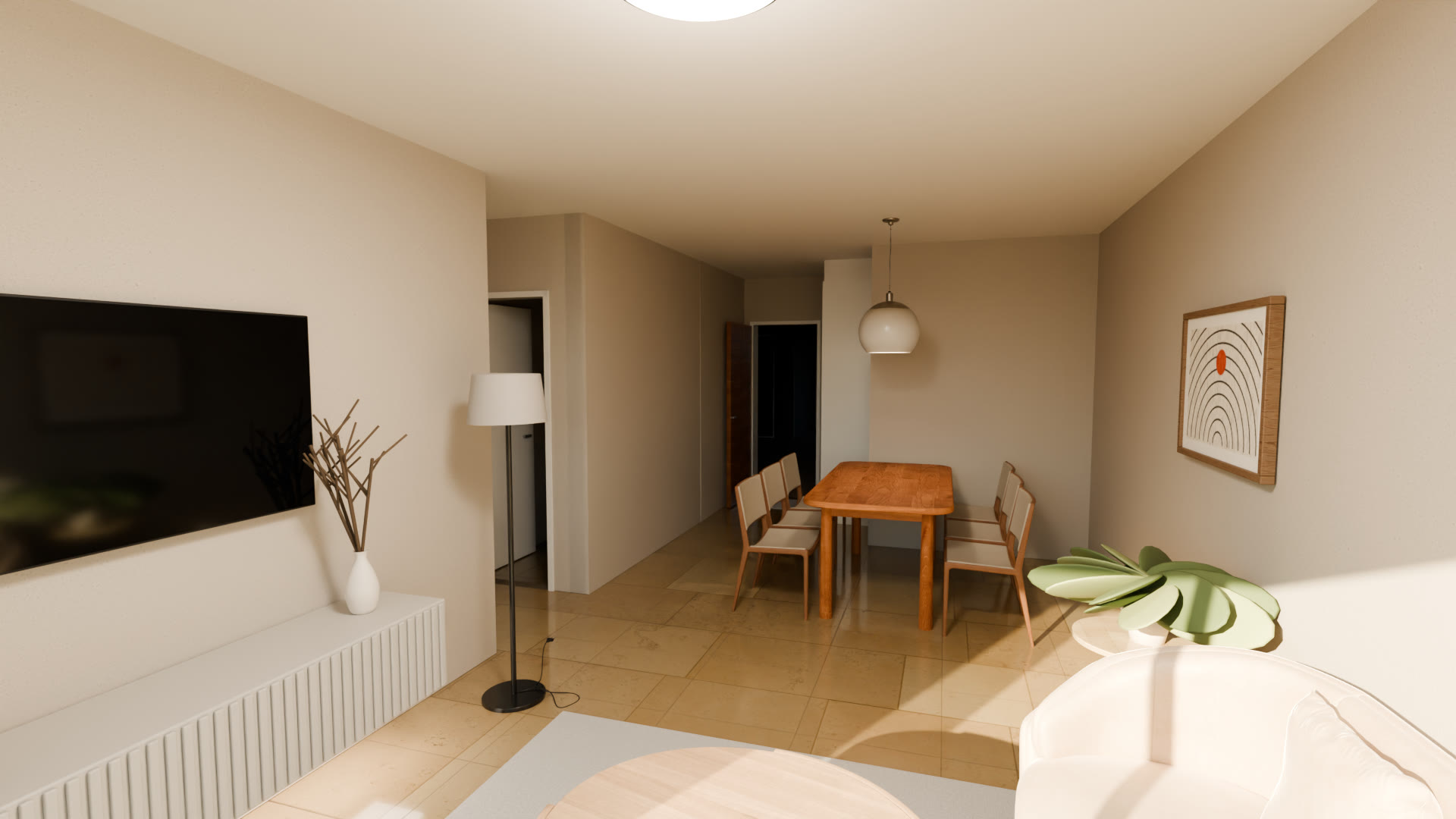
- A walkthrough for each home type, so the buyer can move through the living room, the bedrooms and the terrace at their own pace.
- An availability view: the building with its floors and the homes that are still free. See the interactive unit selector.
The walkthrough is what ties the specification to something the buyer can understand. When the memoria says "porcelain stoneware flooring" and the buyer sees that floor in their living room with afternoon light, the line stops being technical and becomes a reason to buy.
What a 3D walkthrough adds compared with renderings
Renderings are still essential: they're the cover of the development, and portals and social media live on still images. But a rendering shows one angle chosen by the developer. A walkthrough lets the buyer choose where to look.
That changes the conversation in the sales office. Instead of "Is the second bedroom big enough for a double bed?", the buyer walks into it and sees for themselves. Instead of asking whether the terrace gets sun, they look at it in the morning and in the evening. Each question answered on screen is one less reason to delay the reservation.
It also helps with cost. Most developments repeat the same home types across floors. A walkthrough per type works for every floor where that type repeats, so a building with three home types needs three walkthroughs, not one per home. More on that in walkthroughs by unit type.
The buyer who doesn't live in the city
Many buyers of new-build homes in Spain don't live where the development is going up: people from other regions buying a second home on the coast, families buying for a child moving to Madrid or Valencia for college or work, and foreign buyers who decide from their own country.
For all of them, the site office isn't an option on a Tuesday afternoon. What they have is their phone. A walkthrough that opens from a link, with nothing to install, lets them see the home, the building and the surroundings from wherever they are, and share it with whoever decides with them. If you sell a lot to people abroad, there's more in selling to foreign buyers and, for the Mediterranean coast in particular, in the Costa del Sol article.
Showing without overpromising
An off-plan sale in Spain comes with formal steps: reservation, a private purchase contract and payments during construction, with guarantees that depend on each case. That's for the developer's lawyers and for a local professional to explain; the visual material doesn't replace it.
What the material can do is avoid creating expectations that won't be met. A good rule: everything shown in the walkthrough should match the memoria de calidades. If the specification says one kitchen finish, the walkthrough shows that one. If furniture is shown, it should be clear it's decoration and not included. That consistency protects the developer at handover and builds trust from the first visit.
How working remotely with me works
I work from Buenos Aires, Argentina, for developers in other countries, and the whole process is done at a distance:
- You send the plans, the memoria de calidades and any references you have (facade, mood, finishes you like).
- We talk over a video call to agree on what's shown and how.
- You review progress through links and send comments. Approval is yours at every step.
- You receive the renderings and the walkthrough as a link you can send by WhatsApp or email, put on the website or show on a screen in the sales office.
Buenos Aires is four or five hours behind Spain, depending on the time of year, so your afternoon overlaps with my morning: you send comments at the end of your day and have changes the next morning. I work in Spanish and English. If you want to see how your development would look, message me on WhatsApp at +54 9 11 6193-3176 or email facundocampo100@gmail.com.
Pricing is quoted per project, based on the number of home types, renderings and the size of the building. There's more on what drives the cost in how much a rendering costs.
Frequently asked questions
Can a studio in Argentina work on a development in Spain?
Yes. Everything is sent, reviewed and delivered through links, and meetings are over video call. The time difference leaves several shared working hours every day, and the work is in Spanish, so the memoria de calidades and the plans are read without translation.
Does the walkthrough work on the buyer's phone?
Yes. It opens in the browser on any phone or computer, with nothing to install. The buyer can explore it on their own and forward it to whoever is deciding with them.
Is it useful before the development has its building permit?
It can be, as long as the project is defined enough to show. Many developers start presenting to early buyers or investors with the basic design. If the project changes, the material is updated before the full launch. Check what you can advertise at each stage with a local professional.
Do I need a walkthrough for every home?
No. One walkthrough per home type covers every floor where that type repeats. The availability view shows which homes are free, and each one links to the walkthrough of its type.