Brand
The facade rendering: the face of your development on signs, web and listings
In short: The facade rendering is the most widely seen image of any development: site sign, website, listing sites and social media. Showing the building on its real block lets buyers recognize the neighborhood and trust what they're being offered.
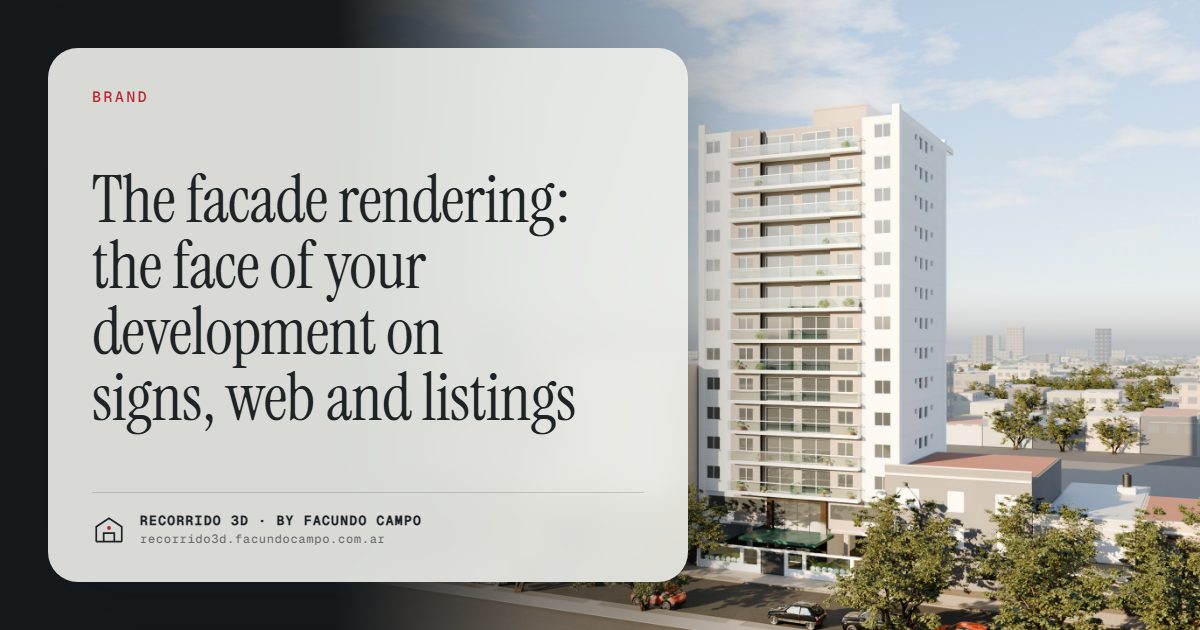
A facade rendering is the exterior image of a development that shows what it will look like from the street before it's built. It's the face of the project: it goes on the construction site sign, the homepage, the first photo on listing sites and every social media post. While the building is still a hole in the ground, that image is what buyers think of as "the building."
Why is the facade the most important image?
Because it's the one the most people see, and the first one they see. Think about everywhere it shows up:
- The site sign, which everyone walking down the block looks at for months.
- The homepage of the development and of the builder.
- The first photo on listing sites, the one that decides whether someone clicks on the listing or keeps scrolling.
- Social media posts and the WhatsApp messages the sales team sends.
- The investor deck, brochures and presentations to banks or partners.
No other image in the project works this hard. An interior gets looked at by people who are already interested; the facade gets looked at by everyone, including people who don't know yet that they're interested. That's why it pays to invest in one or two carefully made exterior views rather than many average ones. On its role in off-plan sales, see renderings for builders.
The first impression sets how everything else is read
The buyer looks at the facade and forms an idea in a second: whether it's an upscale building or just another one, whether the company sweats the details or not. That idea colors how they look at the rest. A facade that looks real and well cared for makes people view the interiors with goodwill. One that looks like a cardboard model raises doubts about everything that follows.
That has direct sales consequences:
- It holds the price. A building perceived as higher-end stands up better when buyers compare price per square foot with others nearby. See defending your price per square foot.
- It gets the inquiry. On a listing site, the cover photo is the only thing people see before they click.
- It builds the brand. The facade of each project gets tied to the builder; it's what buyers remember. More in how a builder grows its brand with every project.
The building on its real block
A building on its own, against a generic background or a plain blue sky, reads as a scale model. Worse, it raises the suspicion that there's something about the surroundings you'd rather not show.
Showing it on its real block, with its actual neighbors, the sidewalk, the trees, the corner and the street, does the opposite:
- Buyers recognize the neighborhood. If they live nearby, they spot the block right away; if they don't, they get a concrete sense of where it is and what's around it.
- They understand the scale. Next to the houses and buildings around it, you can tell whether it's tall or low, whether it stands out or blends in.
- They trust it more. Seeing the surroundings as they are tells buyers there are no surprises. When they go to the block, they'll find what they saw.
- They show up further along in their decision. Whoever saw the block and liked it comes to look at a unit; whoever didn't like it doesn't take up a showing slot.
In the Maconda XXIV building demo, an unofficial working demo based on that 12-story building in Quilmes, near Buenos Aires, marketed by Otamendi Propiedades, the building appears on its block, with its neighbors and its sidewalk. And the facade isn't just a picture: the floors are tappable, and from there you get to the available units. The format is explained in the interactive unit selector.
True to the project, not exaggerated
The facade is a promise. The off-plan buyer keeps it and will compare it with the finished building. So it should show the project as it will actually be:
- The materials and colors in the spec, not pricier ones.
- The real orientation: if the front barely gets any sun, showing it bathed in light sets an expectation that won't be met.
- The surroundings as they are, without erasing the blank wall next door or adding a park that doesn't exist.
An image that over-polishes might bring in one more inquiry, but it costs you at the showing and at handover. A faithful image, well presented, sells just as well and doesn't lead to complaints.
Which views are worth having?
It depends on the building and what you want to highlight, but a typical set includes:
- The main view from across the street, showing the whole facade on its block. It's the cover image for almost everything.
- A street-level view, what the buyer will see when they arrive: entrance, ground floor, retail space if there is one.
- A day view and a night view. The day view shows the materials. The night view, with the windows lit, makes the building feel alive and works very well as a second image.
- An aerial view, when it helps to place the building in the neighborhood, show a rooftop with amenities or a group of homes.
For a mid-block building squeezed between neighbors, the view from across the street is usually the best cover and the street-level one the best second image.
One image, many uses
The same facade gets adapted to each channel: landscape for the website and listing sites, vertical for stories, large format for the site sign. It's worth defining every use from the start so you can order all the versions together. More in renderings and videos for social media and listing sites, and the overall order of materials in what to have ready for a launch.
To get started, all you need is the plans, the address of the lot and the facade materials; the details are in what to send to get started.
I work remotely from Buenos Aires (UTC−3). If you have a building or a house and want to see how its facade would look on its real block, message me on WhatsApp at +54 9 11 6193-3176 or email facundocampo100@gmail.com. I answer in English and Spanish, and we'll go over it with your plans.
Frequently asked questions
What is a facade rendering for?
It's the main image of the development while it isn't built: it goes on the site sign, the website, listing sites, social media and the investor deck. It shapes the buyer's first impression and what they associate with the builder.
Do the neighboring buildings need to be in it?
It's a good idea. The building on its real block lets buyers recognize the neighborhood, understand the scale and trust that there are no surprises. A building floating on a generic background looks like a scale model and raises doubts.
Should the facade be a day or a night view?
They do different jobs. The day view makes a better cover because you can read the materials and colors; the night view, with the units lit up, works really well as a second image and on social media.
Can the same facade be used on the site sign and on social media?
Yes, the same view gets adapted to each format. Ideally you define every use at the start so the landscape, vertical and large-format versions are delivered together.