Sales & pre-construction
How to sell pre-construction faster by showing what doesn't exist yet
In short: Pre-construction sells faster when buyers can see and walk through their unit before it exists, because they stop putting off the decision until construction moves along. Visual material shortens the time between the first inquiry and the deposit.
Pre-construction sells faster when buyers can see, walk through and share the unit they're about to buy, even if the lot is still a hole in the ground. What slows a pre-sale down is almost never price alone. It's the doubt of not knowing exactly what you're buying. If that doubt gets cleared up on the first inquiry, the deposit comes sooner.
Why does a pre-sale stall?
In most projects, the first units go to people the developer knows, to repeat investors and to buyers who already trust the brand. The problem shows up after that: the second wave of buyers doesn't know anyone, can't read a floor plan and isn't in a hurry. Their most common reaction is perfectly reasonable:
"I'm interested, but I'd rather wait and see how construction goes."
That sentence is expensive. Every month the buyer waits is a month the developer funds the build with its own money or with debt, and the unit stays in inventory.
What the buyer is really saying is that they can't see what they're buying. And that can be fixed before the first slab is poured.
What does a buyer need to see to decide sooner?
The doubts that hold up an off-plan deposit are almost always the same. It's worth going through them one by one and asking what material answers each:
- What the building will look like on its street. Not on a white background, but with the neighbors, the sidewalk and the corner the buyer knows. That gives context and confidence that the project is real.
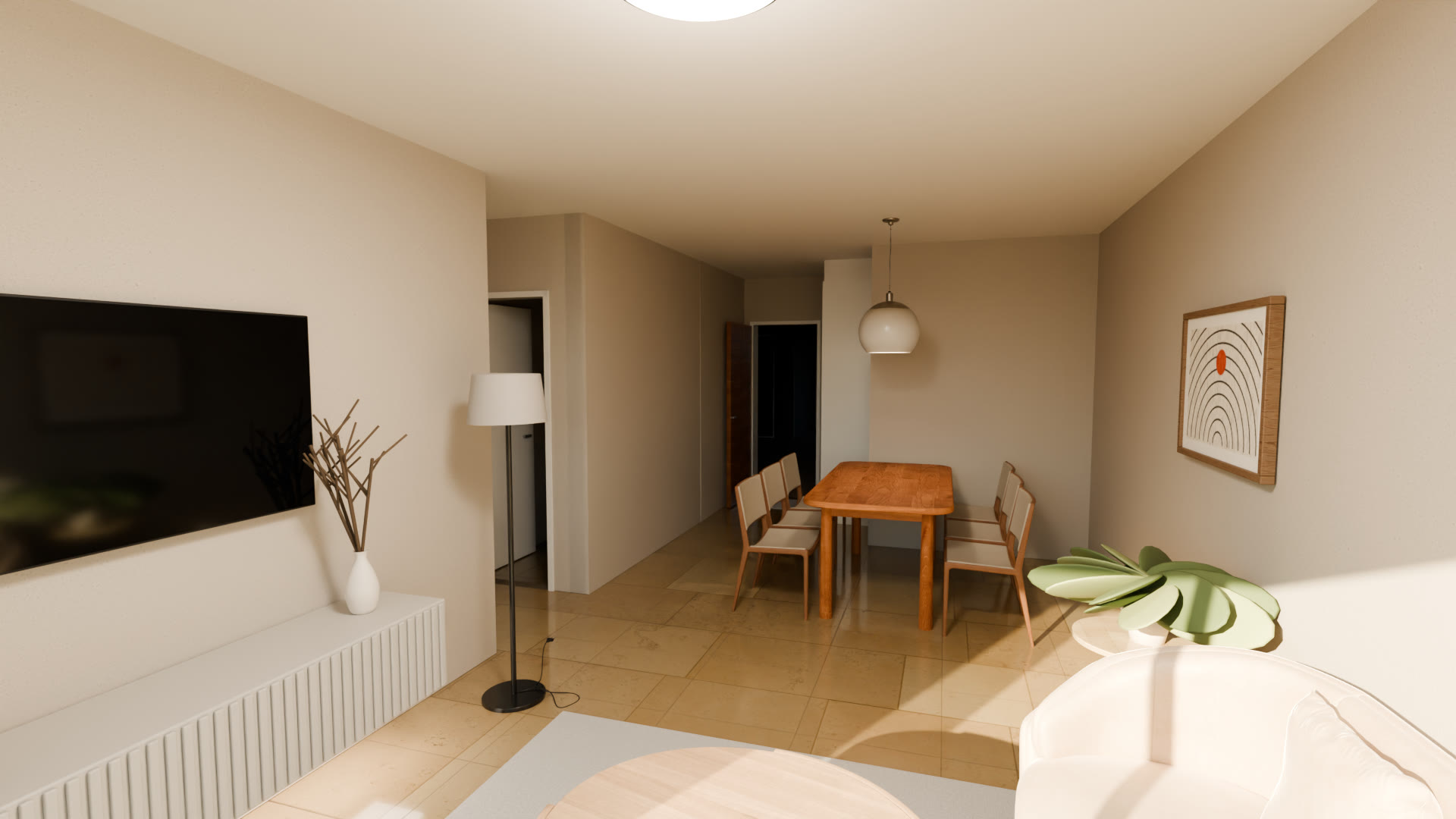
- What the unit is like inside. Where the kitchen is, whether a table for six fits in the living room, how you get to the balcony. A floor plan says it; a walkthrough shows it.
- How much light comes in, and when. Seeing the same room in morning, afternoon and evening light answers a question a floor plan can't.
- Which finishes they get. Flooring, countertops, windows. If they see them applied in the unit, they stop asking "and how does this look?"
- Which unit suits them. Front or back, low floor or high, which ones are still available.
When the material answers all five, the buyer arrives at the meeting with the decision almost made. Your salesperson stops selling the idea of the building and starts closing a specific unit.
Showing what doesn't exist without overpromising
Showing the finished project carries one risk: that what you show doesn't match what you deliver. That's why the material that speeds up a pre-sale sticks to the real dimensions on the plan, the finishes in the spec sheet and the real surroundings of the lot. It's not about making things prettier. It's about letting the buyer see clearly what they're going to get.
That protects the developer too. A buyer who walked through their unit and saw where everything goes files fewer complaints at handover, because they bought knowing. And a buyer who doesn't feel misled is the one who recommends your next project. There's more on this in building a developer's brand.
One person rarely makes the decision
A detail that often gets forgotten: buying a home is almost never one person's call. There's the partner, the parents helping with the down payment, the sibling who "knows about construction." If the prospect leaves your office with a brochure, they have to explain the project from memory to each of them, and the project loses something in every retelling.
With a link to the unit's walkthrough, the prospect forwards exactly what they saw to whoever needs to weigh in. That person opens it on their phone, walks through the apartment with a finger and comments on the same thing. The family conversation goes from "I can't picture it" to "the second bedroom is small, is there a two-bedroom with a bigger one?" That second question is already a sale in progress.
You can see how it works in the Maconda XXIV building demo, an unofficial working demo based on a 12-story building in Quilmes, near Buenos Aires, marketed by Otamendi Propiedades: tap a floor, pick a unit and walk through it on your phone.
What changes between the first and the last units?
A pre-sale doesn't move at the same speed from start to finish. The most sought-after units go first. At the end you're left with the ones that need more explaining: the back unit, the low floor, the less popular floor plan. That's where pre-sales usually get stuck.
Visual material helps most at that stage, because it lets you show the value of each remaining unit instead of cutting the price:
- The back unit is shown with its quiet and its light, not as "the one in the back."
- The low floor is shown with its closeness to the tree-lined street or the shared spaces.
- The less popular floor plan is shown furnished, so people understand how it lives.
In defending your price and raising the average sale I go into how that same logic helps hold your price per square foot down to the last unit.
A simple plan to speed up a pre-sale
If you have a project launching or a pre-sale that has slowed down, this order usually works:
- Have the facade on its real street before you start advertising. It's the image for the sign, the website and listing sites. See what to have ready for a project launch.
- Add a walkthrough for each unit type. A 40-unit building with 3 types needs 3 walkthroughs, not 40, because the same type repeats on several floors.
- Organize inventory in a floor and unit selector. The buyer sees what's available and chooses on their own. More in the interactive unit selector.
- Send the unit link in every follow-up. Not the general brochure: the link to the unit that person was interested in.
- Use the same material in the meeting. Your salesperson walks through the unit with the buyer on a tablet or screen and answers questions about what you're both looking at.
None of these steps promises a number of sales. What they do is clear away the reasons to wait: "I can't picture it," "I need to show my partner," "I'd rather wait and see the building go up."
What if the buyer still wants to wait?
Some buyers will wait anyway, and that's fine. But someone who waits after walking through their unit isn't the same as someone who waits without having seen it. The first one has already picked a unit, has it saved on their phone and goes back to it. When construction moves forward, or when your salesperson lets them know only a few of that type are left, they come back with a decision already made.
The second one starts over from scratch, probably with another project in mind.
I work remotely from Buenos Aires, Argentina (UTC−3): you send the plans, we meet by video call and you get everything by link. If you have a pre-sale about to launch, or one that has stalled, and want to see your project before it's built, message me on WhatsApp at +54 9 11 6193-3176 or email facundocampo100@gmail.com. I answer in English and Spanish.
Frequently asked questions
Does a 3D walkthrough help if construction hasn't started?
Yes, and that's exactly when it helps most. With the plans and the finishes defined, you can show the building on its street and every unit inside. That's what lets you sell before there's anything to visit.
When should the material be ready?
Before the sales launch. If the first listing already shows the facade on its street and the units inside, inquiries come in better informed and early buyers decide sooner.
Can the buyer see it on their phone?
Yes. The walkthrough opens from a link in the phone's browser, with nothing to install, and it can be forwarded by WhatsApp to family or anyone who needs to weigh in.
Do I need a separate walkthrough for every apartment?
No. One walkthrough per unit type is enough, because units of the same type repeat on different floors. That's why the cost depends on the number of floor plans, not the total number of units. See how much a rendering costs.