Markets
3D walkthroughs in Buenos Aires: making one building stand out
In short: In the City of Buenos Aires, an off-plan building competes with several similar ones a few blocks away, with narrow facades and nearly identical floor plans. A 3D walkthrough with the furnished unit, the real light and the building on its block makes the project understood and remembered, and gives the salesperson something concrete to send with every inquiry.
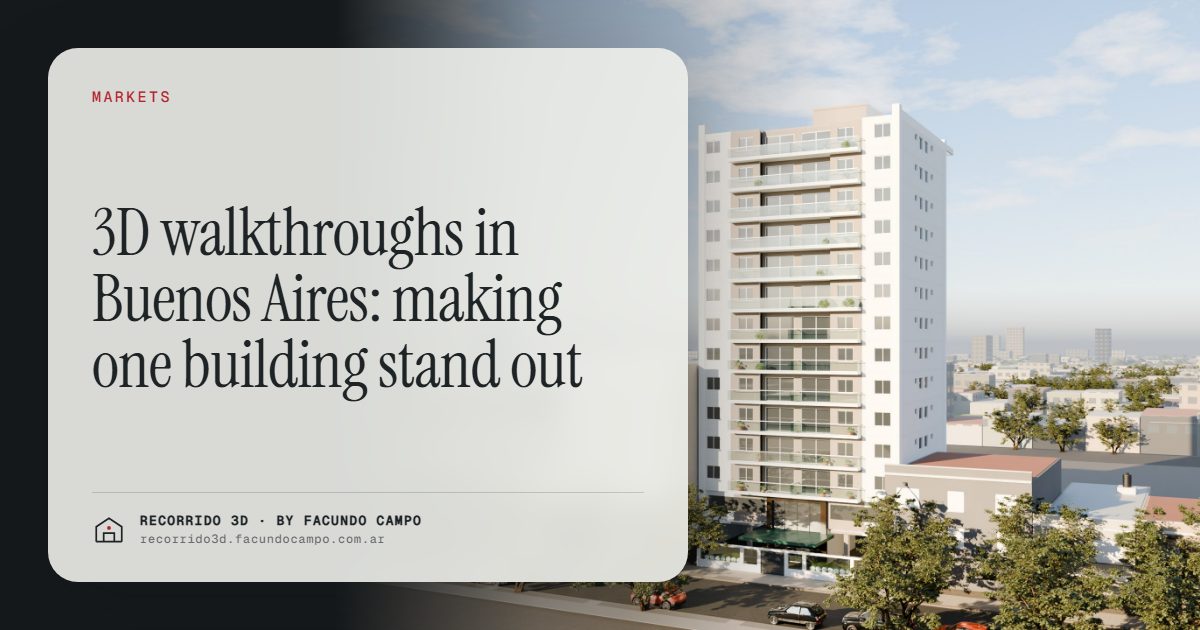
3D renderings and walkthroughs in the City of Buenos Aires help an off-plan building stand apart from the ones going up a few blocks away, with their narrow facades and similar floor plans. When buyers can walk through their unit on their phone, see the real light and see the building on its block, they stop comparing on price alone and start comparing how life would feel in each one.
The Buenos Aires problem: lots of similar buildings a few blocks apart
In neighborhoods like Villa Urquiza, Caballito, Núñez, Palermo, Villa Crespo, Colegiales or Saavedra, a single buyer often has several buildings "en pozo" (off-plan, literally "in the hole") within walking distance. Many follow the same pattern. A narrow lot squeezed between party walls, two or so units per floor, back units facing the green interior of the block, and a rooftop with a shared parrilla (the grill no Buenos Aires building wants to be without).
On a listing portal they look almost identical: a white facade with balconies, a short amenity list and a price per square meter. Buenos Aires buyers tend to do their homework. They build a spreadsheet and choose on price, exact location or how much they trust the developer.
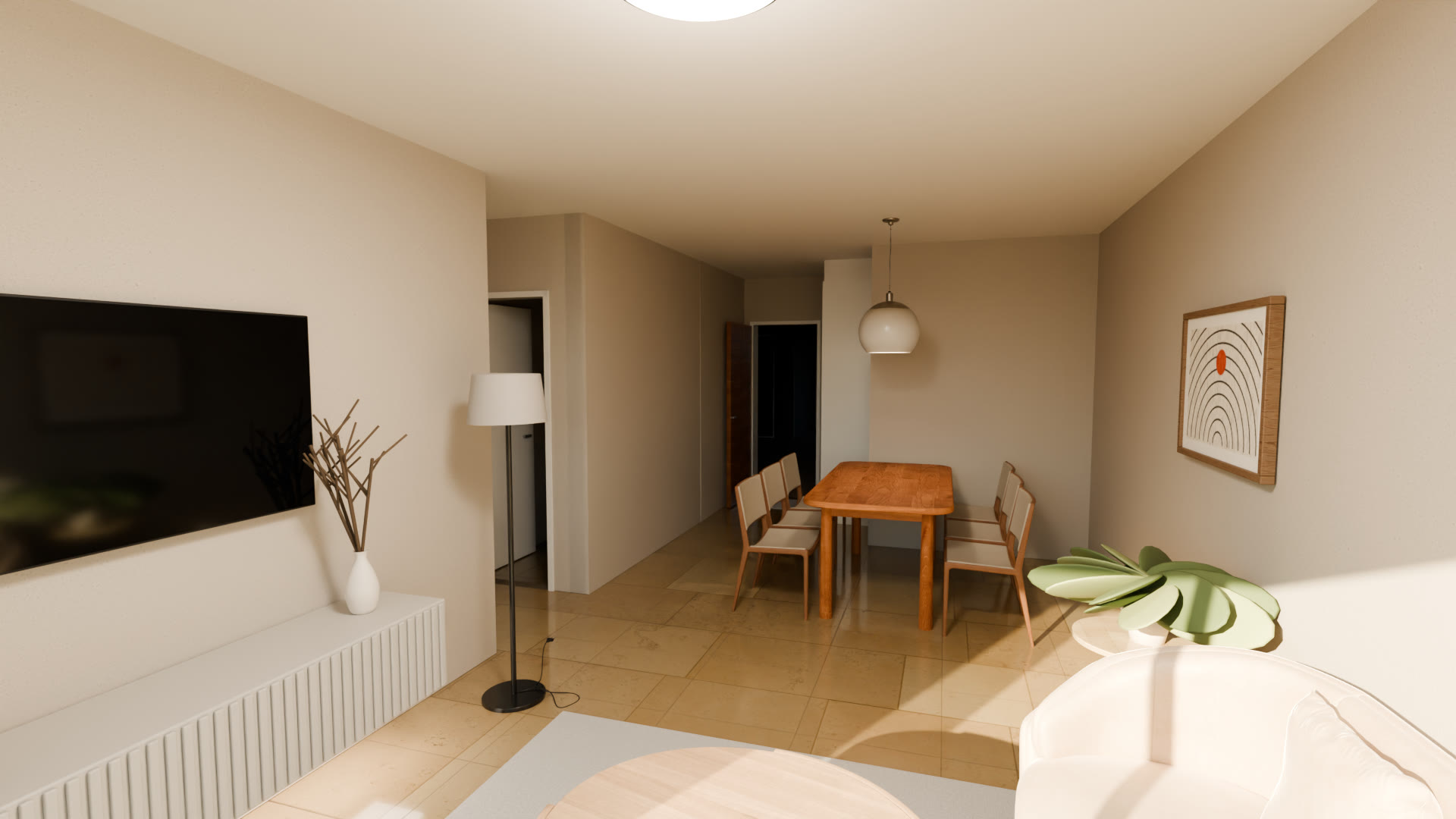
That's where visuals can tip the scale. If one building lets people walk through a furnished unit, with the light it really gets and a balcony overlooking a tree-lined street, it sticks. I go deeper in how to differentiate a real estate project.
Between party walls, light is the argument
On a typical city lot, light is what sets one unit apart from another most. Front units get light from the street. Back units get it from the interior of the block. High floors clear the neighbors' roofs and low floors are more sheltered. Each floor and orientation has its own character, and buyers sense it, but off-plan they can't check.
Showing the same living room in morning, afternoon and night light, from a low floor and a high one, turns a hunch into a decision. The buyer understands why the back unit on the sixth floor can be brighter and quieter than the front unit on the first, and the developer can hold the price gap between floors without explaining it with adjectives. More on this in defend your price per square foot.
What do buyers in the city ask?
Inquiries in Buenos Aires tend to be very specific. A few come up every time:
- How big is the living room, really? Local buyers have all seen apartments where the couch doesn't fit facing the TV.
- Is the balcony usable, or just a railing? A balcony that fits a table for two is a different product.
- Is the second bedroom a bedroom or an office? For a couple planning on kids, the answer decides the purchase.
- What's the kitchen like? Open, half-open, room for breakfast or not.
- What do you see out the window? The street, the interior of the block or the neighbor's wall.
A furnished walkthrough answers all five before anyone books a visit. Inquiries arrive further along, and your salesperson loses fewer afternoons on people who aren't a fit. I explain this in qualified real estate leads.
The person walking by
In the city, a lot of interested buyers find a building on foot. They live in the neighborhood, pass the site sign every day or shop at the store on the corner. They're valuable buyers because they've already chosen the area.
A site sign with a good facade rendering and a QR code that opens the walkthrough turns that walk into an inquiry. The neighbor scans it, walks through the unit on their phone while waiting for the bus and writes that same night. In a QR code on the construction sign I explain how to set it up so it works.
The buyer who lives abroad
Buenos Aires also sells to Argentines living abroad and to investors who aren't in the city, including foreign buyers who know it from visits. For them, seeing the building on its real block, with the corner and the shops they know or can look up on a map, is the basis of trust. They can walk through the unit, share it with a relative who lives in the city and decide without flying in. The legal, tax and currency side of each deal should be checked with a local professional; the visual material covers understanding what you're buying. More in how to sell to investors and buyers who don't live nearby.
You can see how it works in the Maconda XXIV building demo, an unofficial working demo based on a 12-story building in Quilmes, just south of the city, marketed by Otamendi Propiedades: the building on its block, floors you can tap, each floor plate with its units and their availability, and a walkthrough of every apartment.
What should you have ready before launch?
For a building in the city, this package usually goes furthest:
- The facade on its real block, with the neighboring buildings and the sidewalk. It's the image for the site sign, the website and the listing portals.
- A walkthrough of each unit type, with the real light for its orientation. A building with two units per floor and three different types needs three walkthroughs, not one per apartment.
- The rooftop and amenities, even if there aren't many: in a small building, the shared grill is a selling point.
- The floor selector with availability, so buyers see what's left and choose. See interactive unit selector.
How do we work?
I'm based in Buenos Aires and work remotely (Argentina, UTC−3), for local developers and for foreign companies with a project in the city. You send the plans, the finishes and the lot address. You tell me who you want to sell to: a unit for an investor looking to rent isn't furnished like one for a couple moving in. You review and approve over video call or WhatsApp, and you get the images and the walkthrough link, ready for your website, your social media and every inquiry.
If you have an off-plan building in Buenos Aires and want it to stand apart from the others going up in your neighborhood, message me on WhatsApp at +54 9 11 6193-3176 or email facundocampo100@gmail.com and we'll go through your plans. I answer in English and Spanish.
Frequently asked questions
How does an off-plan building in Buenos Aires stand out from others in the same neighborhood?
By showing what the others don't: a furnished unit buyers can walk through, the real light for each floor and orientation, and the building on its block. That takes the comparison away from price per square meter.
Does it help sell back-facing units and low floors?
Yes. Showing the back unit with its light and quiet, or the low floor with its patio or closeness to the entrance, helps sell the units that usually get left for last without cutting their price.
Can a buyer who lives abroad see it?
Yes. It opens from a link on any phone, with nothing to install, and can be shared on WhatsApp or by email with whoever needs to weigh in.