Sales & pre-construction
Virtual staging: why an empty unit sells better furnished
In short: Virtual staging shows an empty or not-yet-built unit as if someone already lived there, with furniture at real scale and the project's finishes. It helps sellers because buyers understand the space, picture themselves living in it and stop discounting the price for what they can't see.
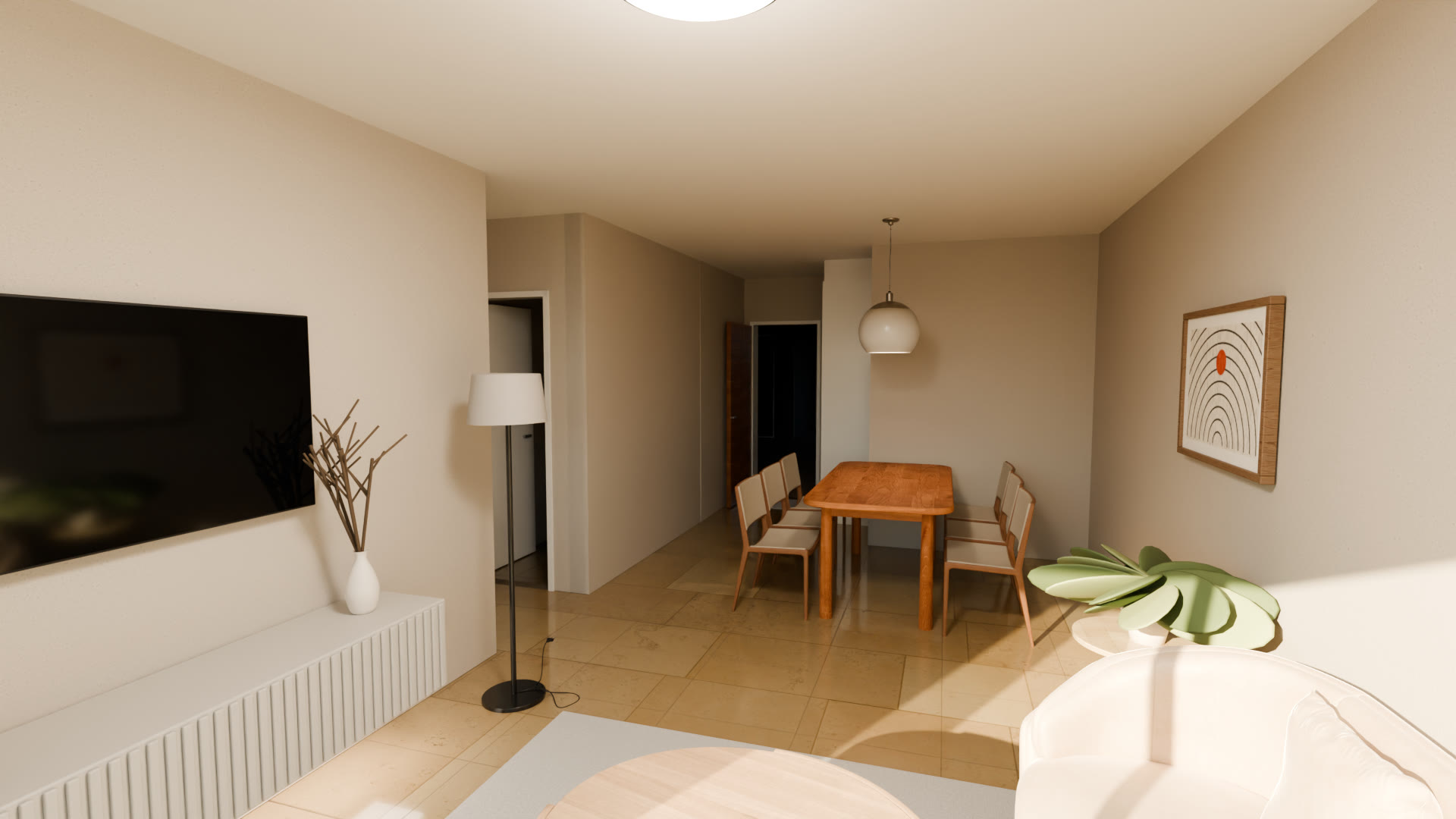
Virtual staging means showing an empty unit, one under construction or one that's still pre-construction as if it were already furnished and lived in, either in images or in a walkthrough that opens on a phone. For the seller, the payoff is concrete: buyers understand the space without effort, picture themselves living there and stop knocking money off the price for what they can't visualize.
Why does an empty unit sell worse?
An empty room tells the buyer nothing. Without furniture there's no sense of scale: the same living room can look huge or tiny depending on the photo. The buyer is left with questions they rarely ask out loud. Does a table for six fit? Where does the sofa go if the window takes up the whole wall? Is there room to open the closet with a queen bed in there?
When those questions go unanswered, two things happen, and neither is good for you:
- The buyer puts it off. "I want to take another look," "I'll come back with my partner." Every delay is a chance for another project in the area to show up.
- The buyer negotiates. Whatever they don't understand, they read as small, dark or awkward, and that turns into a lower offer. Uncertainty always pushes the price down.
Virtual staging answers those questions before anyone asks them. It isn't decoration for its own sake. It proves the space works.
Finished but empty vs not built yet: two problems, one answer
The term covers two situations worth separating, because the sales problem is different in each.
A finished unit that's empty. The building is done and units can be visited, but photos of bare white rooms don't make anyone stop scrolling on a listing site. Staging turns those listings into something people actually look at, and the buyer shows up to the visit already leaning in.
A unit that doesn't exist yet. In a pre-sale there's nothing to photograph. The buyer is paying for something they'll receive months or years from now, and all they have to decide with are floor plans and promises. Seeing the unit furnished, with the finishes that will actually be delivered, is what turns a floor plan into a home. I go deeper into this in pre-construction building sales and in how to sell a pre-sale faster.
How does it help you hold the price?
You defend a price with arguments the buyer can see. If the brochure says "premium porcelain tile" and "open kitchen," the buyer reads it as one more line of copy. If they see it in a finished room, with afternoon light coming through the window and the table set, they understand why that square foot costs what it costs.
The logic is simple. Buyers compare your unit with others nearby. If the others are shown with floor plans or construction photos and yours looks finished and lived in, the conversation shifts from "why is it more expensive?" to "when can I reserve it?" More on this in holding the price per square foot and raising the average ticket.
Does it help qualify inquiries?
Yes, and it's one of the less obvious benefits. When someone has already seen the furnished unit before reaching out, the inquiry arrives pre-filtered. They know whether the living room is big enough, whether the second bedroom works as an office, whether the kitchen is what they wanted. The ones who don't fit drop out on their own, without taking up a showing or a call from your sales team.
The result is fewer people coming by "just to look" and more people asking about payment plans. I explain this in more detail in better-qualified inquiries.
Can buyers walk through the furnished unit?
Yes. Besides still images, the furnished unit can be shown as a walkthrough the buyer moves through with a finger, from the living room to the kitchen to the bedrooms, at their own pace. In the Maconda XXIV demo, an unofficial working demo based on that building in Quilmes, near Buenos Aires, you walk through the furnished apartment on your phone after picking the floor and unit on the building, shown on its real block.
For houses, the Americana 35.64 house demo, based on a Viviendas Roca model, shows the floor plan rising into a furnished house you can walk through in morning, afternoon and night light. A buyer who opens it from their couch is already "inside" before visiting.
If the format interests you, I cover it in 3D walkthroughs for condos.
Do you have to stage every unit in the building?
No. In a building, units of the same type repeat on different floors. Staging one of each unit type covers all of them: a 40-unit building with 3 floor plans needs 3 staged units, not 40. That keeps the cost per unit sold low, and it gets lower the bigger the project is.
Virtual staging or a physical model unit?
A real furnished model unit makes sense when the building is finished and you're getting visitors every day. But it comes with furniture, delivery, upkeep and staff costs, and you get one style in one unit. Virtual staging, on the other hand:
- Exists from the first day of the pre-sale, when a physical model unit is impossible.
- Can be shown in different styles for different buyers: a one-bedroom for a young couple isn't presented the same way as a three-bedroom for a family.
- Travels as a link over WhatsApp, email, listing sites, social media and your website, so it reaches buyers and investors who don't live nearby. See selling to out-of-town investors.
- Gives your sales team something concrete to show in every conversation.
It doesn't replace a visit once the unit is finished, but it covers the whole period before that, which in a pre-construction project is exactly when selling matters most.
Honesty sells too
Good virtual staging shows the space as it really is. Furniture is at real scale, there's room to walk around, and it's clearly labeled as illustrative and not included. That's not just about ethics. A buyer who later finds a unit different from what they saw feels misled right at closing, and that costs the developer's reputation dearly. An accurate image builds trust and referrals.
If you have an empty unit or a pre-construction project and want to see it furnished, send me a message on WhatsApp at +54 9 11 6193-3176 or email facundocampo100@gmail.com. I work remotely from Buenos Aires, answer in English or Spanish, and we'll figure out what makes sense for your case.
Frequently asked questions
What is virtual home staging?
It's showing an empty or under-construction unit furnished and lived in, in images or in a walkthrough, without buying or moving any furniture. It helps buyers understand the scale of each room and picture themselves living there.
Does virtual staging work for a unit that doesn't exist yet?
Yes, and that's when it pays off most. In a pre-sale there's nothing to photograph, and seeing the finished, furnished unit is what lets the buyer decide without waiting for the building to be done.
Can I show the same unit in different styles?
Yes. You can present the same floor plan for different buyer profiles, for example one version for a young couple and another for a family, and use each one in the marketing aimed at that audience.
How much does virtual staging cost?
It's quoted per project. The number of unit types, the number of rooms and images, and whether you add a walkthrough all affect it. I explain how to think about it in how much a rendering costs.