Comparisons
Project video or interactive walkthrough: which to use and when
In short: A project video is the best tool for getting discovered: it tells a story without asking anything of the viewer. An interactive walkthrough is the best tool for deciding: each buyer explores their own unit and answers their own questions. Video works at the top of the funnel and the walkthrough in the middle and at the close.
A project video and an interactive walkthrough do different jobs. The video tells the story: in a minute it gets someone who didn't know your project to want it. The walkthrough lets each buyer explore their own unit and answer their own questions. Video is what gets you discovered; the walkthrough is what helps people decide. Asking "which one?" really means asking where your sale is getting stuck.
What does a video do well?
Video is the best storytelling tool you have. In sixty seconds it can show the building in its neighborhood, the facade at sunset, the lobby, the amenities, a furnished apartment and the balcony view. With music, cuts and on-screen text, it builds a story that makes people want in.
Its main strengths:
- It takes zero effort to watch. The viewer doesn't have to do anything. That matters on social media, where nobody wants to work to understand something.
- You control the story. The developer decides what comes first, what gets highlighted and what feeling it ends on.
- It performs on social and in ads. A reel or a video ad stops the scroll better than a still image. See reels for a development.
- It works on screens. At an expo booth, in the sales office or at a launch event, a looping video draws in people walking by.
More on the format in architectural video and animation.
Where does video fall short?
The same control that makes video strong is also its limit. It shows what the developer chose to show, not what the buyer wants to see.
Look at it from the side of someone who's already interested. They saw the reel, liked it and sent a message. Now they have specific questions: what's the one-bedroom at the back like? Is the kitchen open or closed off? What do you see from the bedroom? The video, which featured the top-floor three-bedroom, answers none of that.
Video is also linear. If the buyer wants another look at the kitchen, they have to scrub back and forth. If they want to see the unit in morning light, they can't, because the video already picked the time of day.
What does an interactive walkthrough do well?
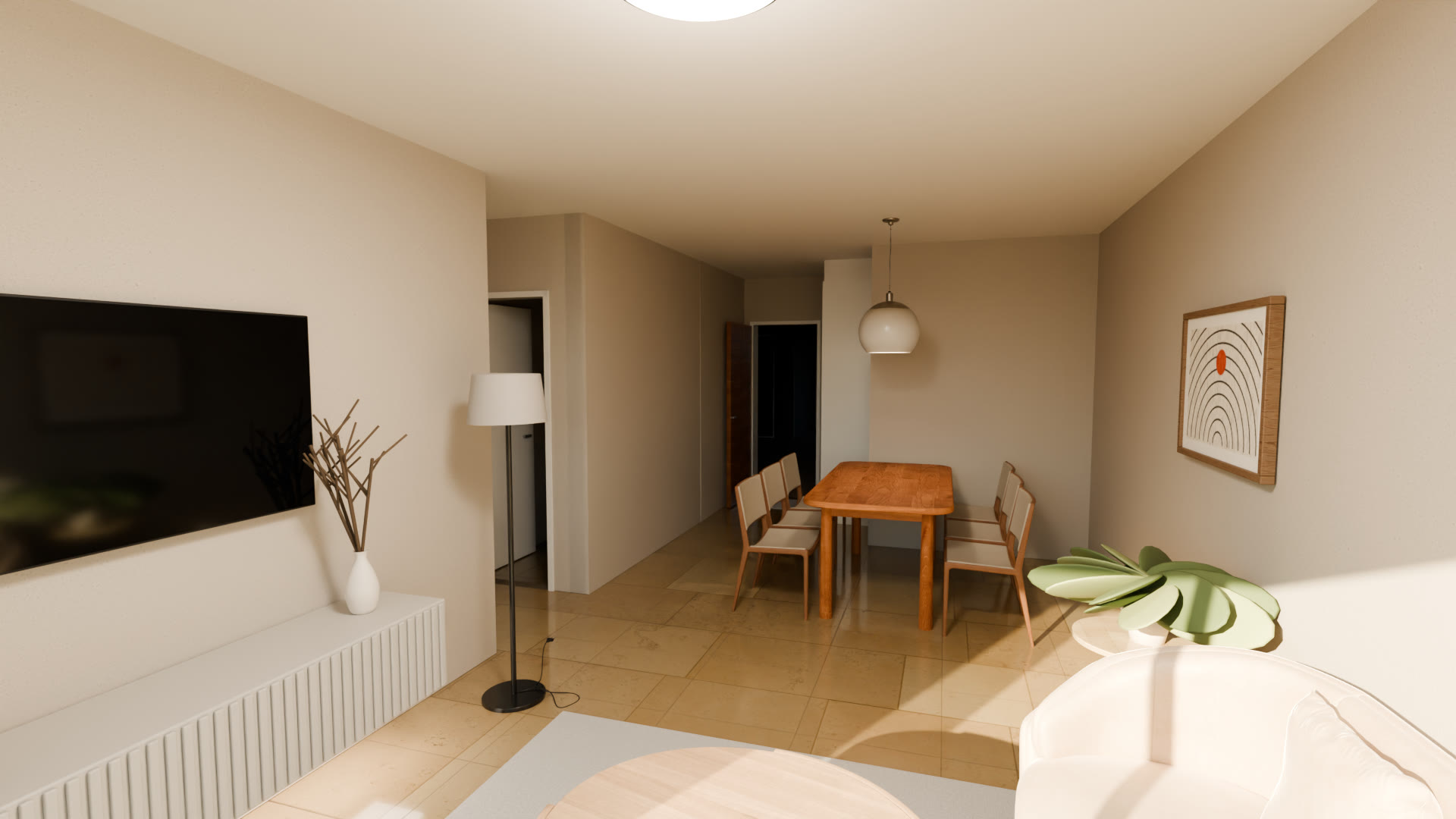
The walkthrough hands the decisions to the buyer. They open a link, pick their floor and their unit, and walk it room by room with a finger or by scrolling. They stop where they care, go back, look out the window.
- It answers each person's questions. Not an average buyer's, but this buyer's, about this unit.
- It shows every unit type. Not just the showiest one. The person looking for a one-bedroom finds theirs.
- It stays with them while they decide. They open it again that night, show it to their partner, compare it with another project.
- It builds in availability. With a building view, they see what's open on each floor before stepping inside.
Try it in the house demo, an unofficial working demo based on the Americana 35.64 model by Viviendas Roca: the floor plan rises into a house and you move through it by scrolling, in morning, afternoon and evening light.
Where does the walkthrough fall short?
To be fair, the walkthrough has limits too. It asks something of the buyer: to tap, to explore. In a social feed, between two random videos, very few people will stop to walk through a unit. The walkthrough pays off once there's interest, not for creating it from scratch.
It also doesn't tell a story on its own. There's no music and no ending designed to move anyone. It's a tool for deciding, not for first attraction.
Each one at its stage of the sale
The clearest way to think about it is by stage:
- Discovery. The buyer doesn't know your project exists yet. This is video territory: reels, ads, the screen at the booth.
- Interest. They saw something and wrote in, or landed on the website. This is where the walkthrough starts working: the agent sends the link to the unit type they asked about. See sending a 3D walkthrough over WhatsApp.
- Evaluation. They compare, talk it over with family, look again. The walkthrough is what keeps them company.
- Close. In the meeting, the agent and the buyer walk through the chosen unit together.
Seen that way, "video or walkthrough?" turns into "which stage is failing me?"
If you can only do one, which should it be?
Look at where your sale gets stuck:
- If hardly any inquiries come in, the problem is at the top of the funnel. A good video for social media and ads helps people find you. See social media ads for developments.
- If inquiries come in but go nowhere, or your agents waste time on showings that lead nowhere, the problem is in evaluation. That's what the walkthrough fixes. See better-qualified inquiries.
- If your buyers are far away, investors in another city or another country, the walkthrough is close to essential, because it's how they visit the unit.
Better together
When the budget covers both, the pairing is natural: the video ends with an invitation to walk through the unit, and the walkthrough is one tap away. Someone who watched the reel taps the link in the bio, picks a floor and walks the apartment. The story the video told becomes concrete.
On top of that, much of the visual material can serve both formats: the facade on its block, the furnished interiors, the sunset light. That's why it makes more sense to plan them together from the start than to tackle them separately. To organize what you need for launch, see the project launch checklist.
I work remotely from Buenos Aires, Argentina (UTC−3), and deliver both formats by link. If you want to figure out what your project needs, a video, a walkthrough or both, message me on WhatsApp at +54 9 11 6193-3176 or email facundocampo100@gmail.com and we'll look at it with your plans. I answer in English and Spanish.
Frequently asked questions
Does a video replace a 3D walkthrough?
No, they do different jobs. The video attracts people and tells the project in the order the developer chooses; the walkthrough lets each buyer look at their own unit and settle their own doubts.
What works best for social media?
Video, because it's effortless to watch and stops the scroll. The walkthrough works better as the link in your bio or in your reply to each message, once the person has shown interest.
Can the same material be used for both?
Much of it, yes: the facade, the interiors and the different times of day work for the video and for the walkthrough. That's why it pays to plan them together from the start.
Can the walkthrough be viewed on a phone?
Yes. It opens from a link in the phone's browser with nothing to install, and it can be forwarded over WhatsApp to family or anyone else who has a say.