Brand
Real estate development investor presentation: how to put it together
In short: An investor presentation for a development has to show clearly the project, the location, the product that will be sold, the numbers and who's delivering it. Images of the finished project and walkthroughs of the units help investors understand what will be sold and to whom.
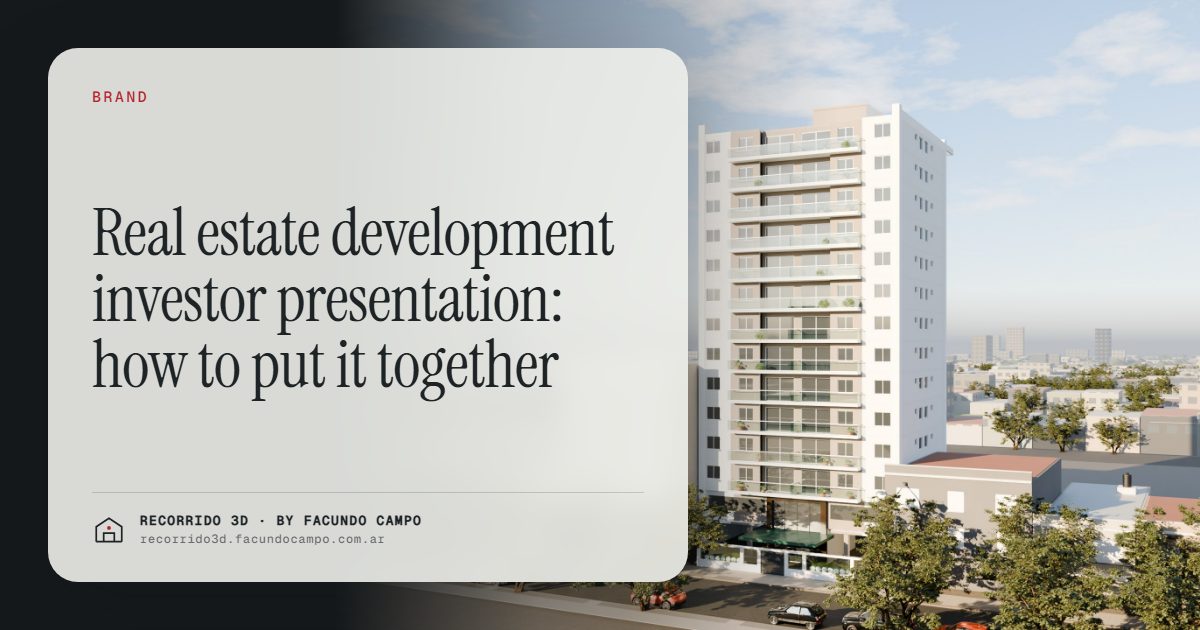
An investor presentation for a real estate development has to answer five things clearly: what the project is, where it is, what product will be sold and to whom, how the numbers work and who's going to deliver it. Renderings of the finished project and walkthroughs of the units don't replace the numbers, but they help investors understand the product behind them, which is what they're really betting on.
How is it different from presenting to a buyer?
A buyer asks: "Do I want to live here?" or "Will this unit rent well?" An investor asks a different question: "Will this project sell, at what price, how fast, and will these people pull it off?"
That changes the emphasis:
- The buyer cares about one unit. The investor cares about the whole project and the mix of units.
- The buyer is moved by the space. The investor is moved by the logic: demand, product, price, timeline.
- The buyer wants to trust the building. The investor wants to trust the team.
But there's overlap. An investor also needs to believe that buyers will want those units. If the product is hard to picture, that belief is harder to build. That's where the visuals come in.
The structure that works
There's no fixed template, but a clear order helps the investor follow the story. Something like:
- The project in one slide. A strong image, the name, the location and a sentence about what it is.
- The site. Where it is, what's around it, why this location. An aerial rendering explains this better than a map.
- The market and the buyer. Who will buy these units and why. Reasoning you can defend, not numbers you can't.
- The product. Unit types, sizes, amenities, finishes. This is where renderings and walkthroughs do the most work.
- The numbers. Costs, expected sales, timeline, financing structure, returns. With your own figures, clearly labeled as projections.
- The team. Who designs, who builds, who sells, and what they've delivered before.
- The risks and how you handle them. Investors trust a team that names its risks more than one that pretends there are none.
- The ask. What you need, on what terms, and the next step.
Show the product, not just the numbers
Many investor decks are spreadsheets with a logo. The numbers are essential, but they describe a product the investor has to imagine.
Visuals close that gap:
- The facade on its real street shows that the project fits and stands out in its location.
- Interiors of the main unit types show that the product is attractive to the buyer you described.
- A walkthrough of a unit, that the investor can open on their phone, shows the layout works and the spaces feel right.
- Amenities and common areas show where part of the value comes from.
An investor who can walk through a unit understands why it will sell at the price in your projections. You can see what that looks like in the Maconda XXIV building demo, an unofficial working demo where you tap a floor, see the units and walk through each one.
Investors who don't live nearby
Many investors won't visit the site, at least not before the first conversation. They might be in another city or another country, reviewing several opportunities at once.
For them, the presentation has to work without you in the room:
- Send it as a light PDF with links, so they can open it on a phone.
- Include a link to the walkthrough, so they can explore the product on their own.
- Explain the location for someone who doesn't know it, with landmarks they'd recognize.
- Offer a video call to go through it together.
More on reaching people who aren't local in selling to remote investors and buyers. Investment rules and the legal side of raising capital vary by country, so it's worth checking with a local professional.
Mistakes that cost trust
- Numbers without sources or assumptions. Investors will ask where each figure comes from.
- Images that oversell. A view that won't exist or an amenity that's not in the budget undermines everything else.
- Too many slides. A presentation that needs an hour to read gets skimmed. The detail can go in an appendix.
- No team slide, or a vague one. The team is often what investors weigh most.
- Ignoring the risks. Every project has them. Pretending otherwise looks naive or evasive.
One base for many pieces
The images you prepare for investors don't have to stay in the deck. The same facade, interiors and walkthroughs later feed the website, listings, the brochure, the construction sign and social media.
That's a good reason to order the sales material early: what you create to raise capital becomes the base of the sales launch. And once the project is delivered, the renderings next to the photos of the finished building go into the project portfolio, which helps with the next round of investors.
I make renderings and walkthroughs for developers, working remotely from Buenos Aires, Argentina (UTC−3). If you're preparing an investor presentation and want the product to look as solid as the numbers, message me on WhatsApp at +54 9 11 6193-3176 or email facundocampo100@gmail.com. I answer in English and Spanish.
Frequently asked questions
What should a real estate investor presentation include?
The project, the site and its surroundings, the target buyer, the product (unit types, finishes and amenities), the numbers with their assumptions, the team, the risks and what you're asking for.
Should renderings go in an investor presentation?
Yes. They show the product the numbers describe, and help investors believe buyers will want those units. They don't replace the financials, but they make them easier to trust.
Can a 3D walkthrough be included in the presentation?
Yes, as a link inside the PDF or shared alongside it. The investor opens it on any phone or computer and walks through the units without installing anything.
Can the presentation material be used later for sales?
Yes. The same renderings and walkthroughs work for the website, listings, brochure and social media, so the effort serves both the capital raise and the sales launch.