Renders
How to choose a 3D rendering studio when the goal is to sell
In short: To choose a 3D rendering studio, check whether the work looks real, whether it holds up on a phone, whether it can be shared with a link, and whether deliverables, revisions and deadlines are in writing before work starts.
To choose a 3D rendering studio, start from how you'll use the work to sell: the images have to look real, the material has to look good on your buyers' phones, it has to be shareable with a link, and the deliverables, number of revisions and deadlines have to be in writing. The technical side is the studio's problem. Yours is making sure the material helps you close deals.
Start with the right question: what do you need it for?
Before asking for quotes, pin down the sales goal. These are very different jobs:
- Launching pre-construction sales for a building and needing the facade, interiors and a way to show what's available.
- Selling a catalog home that gets built on lot after lot.
- Listing a brand-new property that doesn't have any furniture yet.
Each one calls for different material. With a clear goal, every studio quotes the same thing and the comparison is fair. If you're selling a building, read how to use renders in pre-construction building sales before you ask for prices.
Do the images look real?
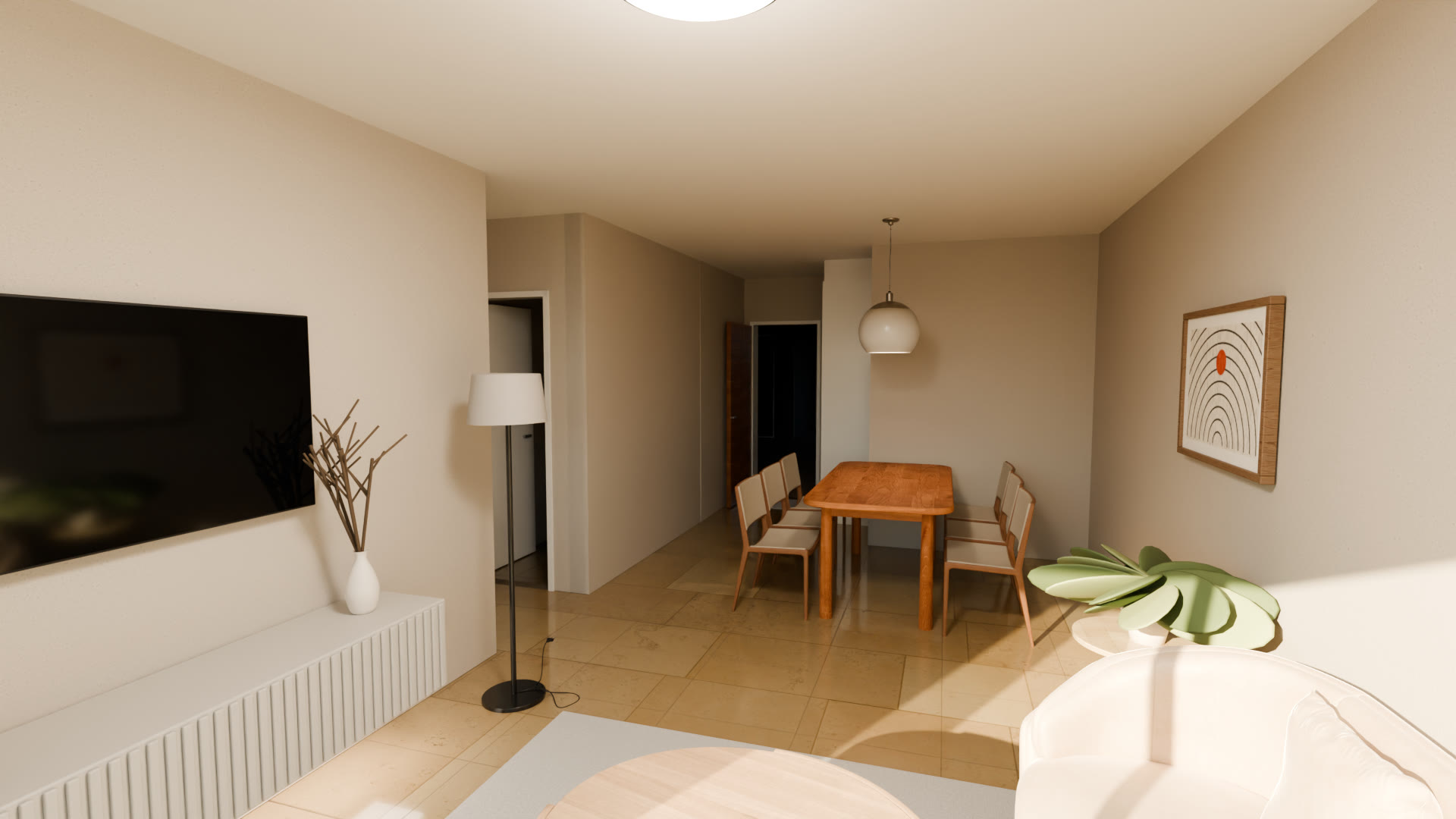
This is the first filter and the most important one. A render that "looks like a render" creates distrust: the buyer suspects something is being hidden or that the building won't turn out that way. A render that looks like a photo makes the project feel concrete and takes some of the fear out of buying something that doesn't exist yet.
Look at the portfolio like a buyer, not like an architect:
- Do you want to be in that room? If a living room doesn't make you feel anything, it won't do anything for your customer either.
- Is the quality consistent? Watch out for two stunning images and a weak rest. Ask to see a complete project, not just the best shot.
- Are there interiors and exteriors? If you're selling apartments, you need both done well.
- Is the setting believable? A facade floating on a generic background sells less than the building on its actual street.
Does it look good on a phone?
Most of your prospects will see the material on their phones, often from an ad or a WhatsApp or text message. Ask the studio for a link and open it on your own phone, on mobile data, not on the office Wi-Fi.
Check whether it loads fast, whether it makes sense without instructions and whether you can use it with one finger. A walkthrough that takes too long to open, or looks tiny on a phone, loses people in the first few seconds. You can compare with my building demo: it opens on any phone without installing anything.
Can it be shared and embedded?
Material that doesn't get passed around doesn't sell. Ask:
- Whether the walkthrough or gallery can be shared with a single link your sales rep can send by message.
- Whether it can be embedded on your website under your brand, without sending visitors to someone else's site.
- Whether the images come in sizes meant for listing sites, social media and print.
This has a direct effect on your sales team's daily work. I go into it in the 3D walkthrough as a sales team tool.
Exactly which deliverables are included?
Compare quotes by what they deliver, not by the bottom line. Ask every studio to spell out:
- How many images, of which rooms, and at what sizes.
- Whether it includes video, an interactive walkthrough or a furnished floor plan.
- For a building, whether the walkthrough is done per unit type. One walkthrough per type covers every floor where it repeats: 40 units across 3 floor plans means 3 walkthroughs, not 40. That difference changes the total a lot.
- Whether there's a way to show the floors and units with their availability. See interactive unit selector.
- How long the walkthrough stays online and who maintains it.
To understand how a price is built, see how much a rendering costs.
How are revisions handled?
Revisions are the main source of delays and arguments. A good studio explains, before starting, at which points you approve (camera views, materials, final image) and how many rounds of changes are included at each one.
Also ask what happens if the project changes halfway through: whether it's quoted separately, how you'll be told, and how much it pushes the date. Getting that clear up front avoids surprises and lets you plan the launch calmly.
Are the deadlines in writing?
A launch has a date: the sales event, the site sign, the social media campaign. If the material is late, everything else slides. Ask for a written schedule with:
- What the studio needs from you, and by when.
- When you'll see the first draft.
- When you'll get the final delivery.
A studio that commits in writing is a studio that has already thought about how it's going to deliver. If you're building the whole calendar, what to have ready for a project launch will help.
Does the studio understand how you sell?
Finally, pay attention to the questions the studio asks you. If it only asks about plans and measurements, it'll hand you images. If it asks who you sell to, which selling point you want to push and where your inquiries come from, it'll hand you material that sells. You can see that difference in the result.
Does the studio need to be local?
Not really. Distance matters much less than it used to, as long as the studio understands your market and your buyer. I work remotely from Buenos Aires, Argentina (UTC−3): you send the plans, we talk over video call, you approve by message, and everything arrives as a link.
If you want to compare against a real case, send me your project on WhatsApp at +54 9 11 6193-3176 or by email at facundocampo100@gmail.com. I answer in English or Spanish, and I'll tell you what I'd do, what I'd deliver and when, all in writing.
Frequently asked questions
Should I go with the cheapest quote?
Only if it delivers the same as the others. Compare the list of deliverables, the revisions included and the deadlines. A lot of the time, the price gap is in what's left out.
Does the studio have to be in my city?
No. The work runs fine remotely: you send the plans, approve by message or video call and get everything by link. What matters is that the studio understands your market and your buyer.
What should I ask for to test a studio before hiring?
A link to a complete project that you can open on your phone to see how it behaves. That tells you more than any single portfolio image.
What needs to be in writing?
Deliverables with quantities and sizes, the rounds of revisions included, a schedule with dates, what happens if the project changes, and how long the interactive material stays online.