Renders
Renderings for project approval: partners, boards, condo associations, clients
In short: A rendering for project approval lets whoever has to say yes, whether partners, a board, a condo association or a private client, see the result before committing money. It cuts down arguments, speeds up the decision and avoids expensive changes halfway through construction.
A rendering for project approval lets the people who have to say yes see the result before they commit money: the partners in a development, a company's board, a condo association or the private client of an architect. When everyone is looking at the same finished image, discussions get shorter, decisions come sooner and the expensive "that's not what I imagined" moments happen on screen instead of on site.
Why do projects stall before they start?
Rarely because the design is bad. More often it's because the people approving it don't fully understand what they're approving. Three things tend to happen:
- Everyone imagines something different. The architect looks at the plans and sees everything; the financial partner sees lines and doesn't know what they're signing off on.
- Nobody wants to be the one who said yes to something that went wrong. When in doubt, people ask for more information, another meeting, another version.
- Objections show up late. Someone who didn't understand the drawings discovers during construction that they don't like the facade, and the change costs far more than it would have on paper.
A clear image of the finished result addresses all three.
Who approves, and what do they need to see?
Partners and investors in a development
They want to know whether the project will sell. Beyond the architecture, they look at the product: how the units feel, what the facade says about the price range, how the building compares with others nearby. The renderings they approve are often the same ones that will later go into sales, so it's worth thinking of them that way from the start. There's more in how to put together an investor presentation.
A company's board
For a corporate headquarters, a new branch or a plant, the board is approving image and functionality. They want to see the building in its location, the entrance their clients will use and the spaces their people will work in. A short set of well-chosen views is better than a thick dossier. See office renderings.
A condo association
When a building's owners have to vote on a facade renovation, a new lobby or a rooftop project, getting agreement is hard. Each owner pictures something different and many are wary of the cost. Showing the before and after from the same angle, ideally with two options, turns a long meeting into a choice between visible alternatives. The logic is the same as in renovation renderings.
An architect's or builder's private client
For a family building a home, the decision is personal and the money is significant. Seeing the house finished, inside and out, gives them confidence and reduces late changes. It also helps the architect defend design decisions with an image instead of an argument.
What should you show to get a yes?
- The exterior in its real surroundings. So nobody gets a surprise about how the project looks on its street.
- The spaces where decisions are made. The lobby, the kitchen, the living room, the facade: wherever there are design or finish options the approver has to choose from.
- Options side by side. Two facades, two claddings, two layouts. Approving by choosing between visible options is much faster than approving in the abstract.
- Human scale. People, furniture and cars that make the real size of things clear.
A still image or a walkthrough?
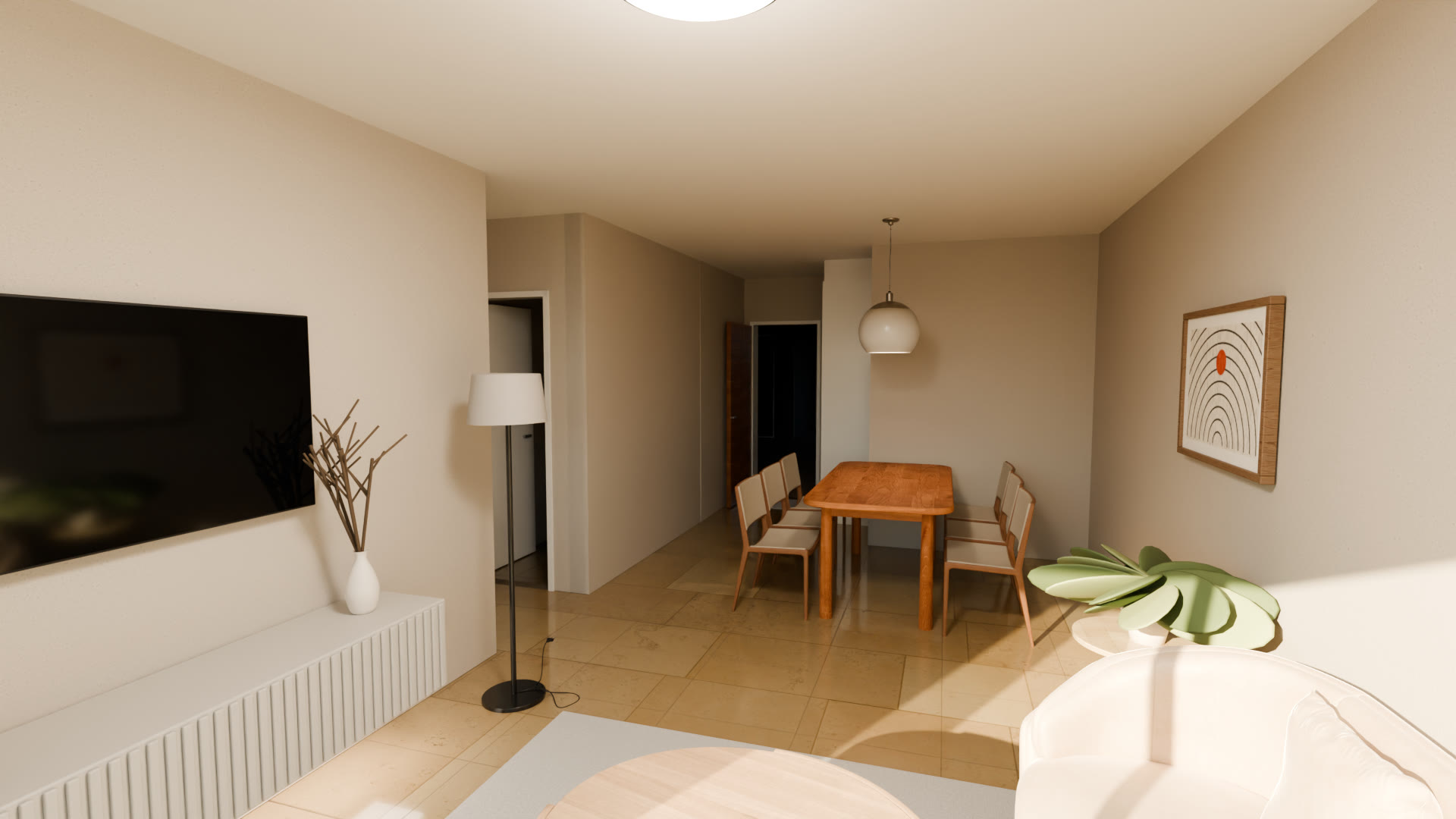
Still images work well for presentations and meetings: everyone looks at the same thing, and it's easy to point at a detail. A walkthrough helps when the question is about space: how the rooms connect, whether the lobby feels generous, what you see from the terrace. It also lets each approver explore at their own pace before the meeting, so they arrive with questions instead of confusion.
In the Americana 35.64 house demo, an unofficial working demo based on a model by Viviendas Roca, the floor plan rises into the house as you scroll, with morning, afternoon and night light. For a building, the Maconda XXIV demo, based on a building in Quilmes, near Buenos Aires, shows each floor and unit on a phone.
Approving at a distance
Many approvals happen with people in different cities or countries: an investor abroad, a board split across offices, owners who don't live in the building. A link that opens on any phone means everyone sees the same thing without traveling. They can look at it again before voting, forward it to an advisor and come to the meeting already informed. It's the same advantage covered in selling to remote investors and buyers.
Approval material sells, too
The renderings used for approval rarely go to waste. Once the project is approved, the same images can go on the site sign, the website and social media. That's why it pays to make them with the quality of sales material from the beginning, rather than as rough sketches that will need redoing later.
How remote work happens
You send the plans, the elevations and the options you want to compare. I work from Buenos Aires, Argentina, on UTC−3, which overlaps with business hours across most of the Americas and part of the European afternoon. You review and approve the views by email or video call, and you get images and, if needed, a walkthrough link ready for the approval meeting.
If you need to get a project approved and want everyone to see the same result before deciding, message me on WhatsApp at +54 9 11 6193-3176 or email facundocampo100@gmail.com. I answer in English and Spanish.
Frequently asked questions
What does a rendering do in a project approval?
It lets everyone involved see the finished result before committing money. That reduces misunderstandings, shortens discussions and prevents expensive changes once construction has started.
Is it better to show options or a single proposal?
Usually options. Choosing between two or three visible alternatives is faster and easier than approving a single proposal in the abstract, and it gives approvers a sense of control.
Does it work for a condo association vote?
Yes. A before-and-after image from the same angle, ideally with two options, helps owners understand the proposal and makes the vote more straightforward.
Can approval renderings be used later for sales?
Yes, if they're made with sales quality from the start. The same images can go on the website, the site sign and social media once the project is approved.